How AI Memory Is Transforming Digital Assistants for UK Businesses in 2025
Discover how AI memory is transforming digital assistants in 2025. Learn why context engineering, on-device AI and long-term memory are becoming essential for UK and Ireland small businesses, nonprofits and consultants. This article explains how memory-driven AI improves accuracy, protects privacy, reduces costs and delivers consistent, personalised support across tasks. A practical guide for teams adopting ethical, privacy-first AI tools.
Thomas Gerritsen
12/8/20254 min read
How AI Memory is Revolutionising Digital Assistants for UK Businesses in 2025
AI adoption is accelerating across the UK and Ireland but a key limitation has hindered productivity gains: most AI systems forget everything you tell them. This “digital amnesia” is a major reason teams test AI tools, become frustrated and revert to manual processes. Small businesses, non-profits and consultants need digital assistants that understand context, retain important details and adapt to various tasks.
A new generation of memory-driven AI assistants is emerging in 2025, designed to overcome these limitations. With the rise of on-device AI hybrid architectures and advanced context engineering businesses can finally utilise AI that behaves like an intelligent partner rather than a one-off prompt machine.
This article delves into how AI memory functions, its significance for small organisations and how businesses can begin integrating long-term privacy-first AI assistants into their digital strategy.
Why Most AI Tools Fail: The Problem of Digital Amnesia
Traditional AI tools are stateless, meaning each conversation starts with no memory of previous instructions tone or preferences. Forbes highlights that users abandon these tools when they’re forced to repeatedly explain the same context and correct the same mistakes.
This leads to predictable friction:
- AI forgets project history, making it difficult to maintain continuity across tasks and days.
- Teams often have to re-explain instructions, requiring brand guidelines processes and constraints to be restated repeatedly.
- Multi-step workflows break down as the assistant loses track of previous steps or decisions.
- Institutional knowledge disappears because AI can’t retain insights that staff rely on daily.
Stateless AI limits productivity because it can’t think in a sustained or relational way. Memory is no longer optional; it’s fundamental.
The Rise of AI Memory and Context Engineering
In 2025, the key change in AI design isn’t bigger models but smarter memory. Context engineering is now a core AI skill, allowing systems to retain history, utilise long-term knowledge and personalise their behaviour.
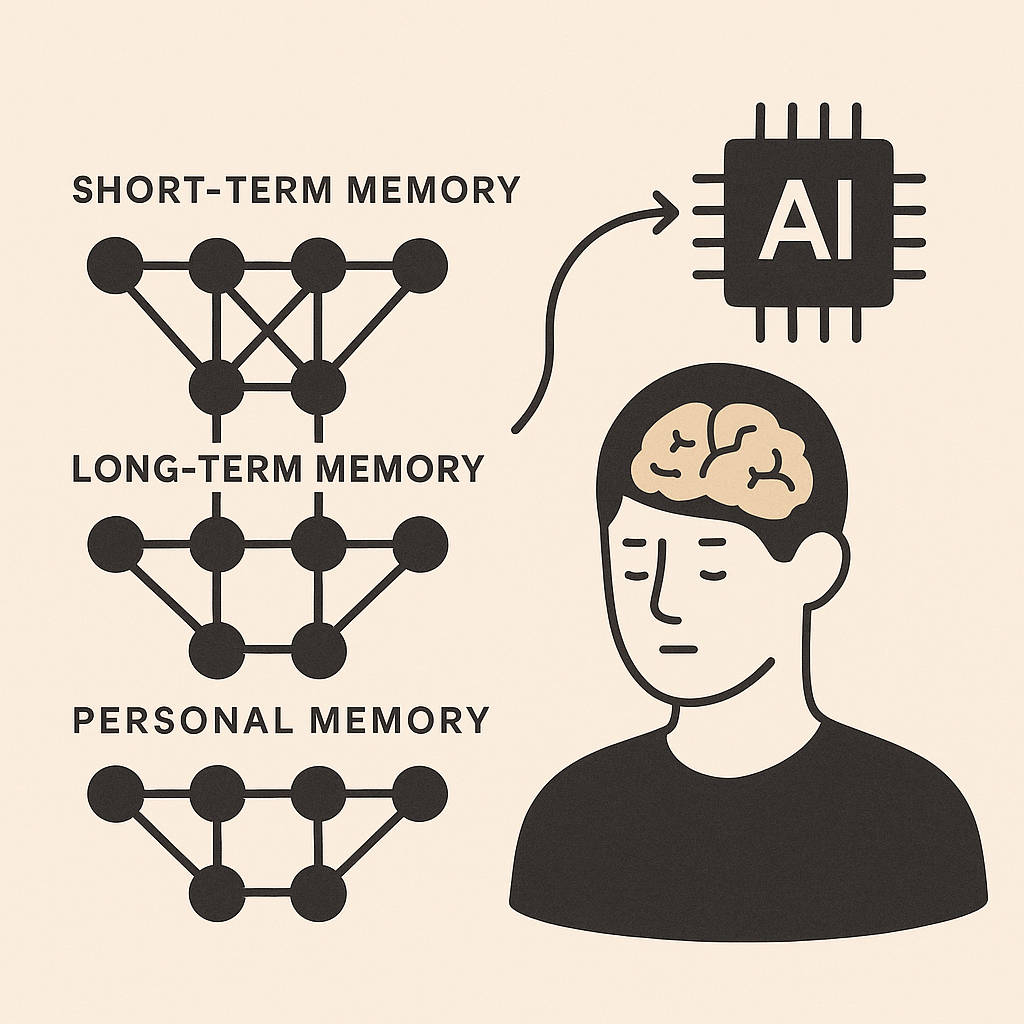
Context engineering employs three memory layers:
Short-term memory: A sliding window of recent conversations that maintains continuity within a single session.
Long-term memory: A structured knowledge store, often a vector database, containing documents decisions policies and historical interactions.
Personal memory: Preferences writing style schedules tone and organisation-specific patterns.
When these layers collaborate, an AI assistant becomes capable of sustained reasoning context-aware recommendations and personalised support over days weeks and projects.
This shift significantly reduces hallucinations and enhances reliability as the assistant draws from structured relevant information rather than making guesses.
How Memory-Driven AI Benefits SMEs and Nonprofits
For smaller organisations, memory-capable AI assistants can create immediate and measurable impact.
1. Consistent Output Across Teams
The assistant remembers brand voice, compliance rules, customer preferences and internal processes, reducing errors and rework.
2. Faster Task Completion
When context is retained, AI can generate documents, emails, reports and content with far less prompting.
3. Improved Customer Experience
AI systems can recall previous interactions, service notes and support history, strengthening trust.
4. Operational Resilience
Long-term memory preserves knowledge that might otherwise disappear when key staff leave, change roles or reduce hours.
5. Stronger Privacy and Regulatory Compliance
When memory is stored locally or within private cloud infrastructure, businesses protect customer data while ensuring continuity. On-device AI is particularly powerful here.
Memory enables AI to behave like a real digital colleague, not a disposable chatbot.
On-Device AI Agents: Private, Persistent and Built for Real Work
Research underscores a substantial shift towards on-device AI agents. Modern phones and laptops can now locally run multi-billion-parameter models, achieving around 30 tokens per second without cloud reliance.
This has significant implications for businesses:
Data remains on the device, safeguarding sensitive information and maintaining user control.
Costs decrease substantially as local inference eliminates the need for costly cloud requests.
Offline capability improves reliability, enabling rural teams and travelling staff to utilise AI even without connectivity.
User trust increases as Samsung and Apple prioritise user-controlled privacy settings for on-device processing.
When combined with long-term memory, mobile AI agents transform into powerful portable assistants. They manage schedules, documents, voice notes and operational tasks all without exposing your organisation to unnecessary data risk.
Why Context Is Becoming the Most Important AI Capability
Memory, not scale, will shape the next wave of AI adoption. Tools that remember users processes and documents will outperform those that simply generate text.
This shift is driven by several factors:
AI without memory creates friction and users stop relying on forgetful assistants.
Structured context significantly improves accuracy and relevant knowledge prevents hallucinations.
Personalisation boosts engagement and ROI while teams adopt AI more consistently when it adapts to their needs.
Private memory aligns with UK/EU regulations allowing businesses to securely store knowledge minimising risk and demonstrating responsible governance.
Context is quickly becoming a competitive advantage for digital consultancies software providers and internal IT teams.
How Small Organisations Can Start Using Memory-Driven AI
You do not need a full AI engineering team to deploy contextual assistants. Begin with these steps:
Step 1: Identify High-Friction Tasks
Look for areas where repetition, re-explanation or manual formatting slows the team down.
Step 2: Build a Context Library
Create structured documents for brand guidelines, workflows, FAQs, templates and SOPs.
Step 3: Choose Privacy-First AI Tools
Prefer on-device or hybrid systems that keep memory secure and under your organisation’s control.
Step 4: Integrate Retrieval Systems
Connect your documents and processes to the assistant so it can reference them intelligently.
Step 5: Train Your Staff in Context-Based Prompting
A small amount of training unlocks significant improvements in output and consistency.
This scaffolding is where consultants add the most value: transforming scattered information into structured, high-trust AI memory.
The Future of Digital Assistants
The next generation of AI won’t just automate tasks; it’ll build relationships, learn preferences and support long-term goals. Assistants will remember: how your organisation communicates, which customers need more support, your regulatory boundaries and preferred workflows. AI tools that understand will replace those that merely respond.
For SMEs, nonprofits and purpose-driven teams, this is a turning point. Memory-driven AI can extend capacity protect privacy strengthen operations and build trust with your communities. This is the future The Cultured Code is preparing organisations for.
Take the Next Step
Schedule a discovery call to assess whether memory-driven AI can support your digital strategy.
Request a free digital review to identify high-impact use cases for contextual AI tools.
Email contact@theculturedcode.com to explore privacy-first AI solutions for your organisation.